Static Stretching Before a Workout Feels Responsible — Sports Medicine Has Been Quietly Disagreeing for Twenty Years
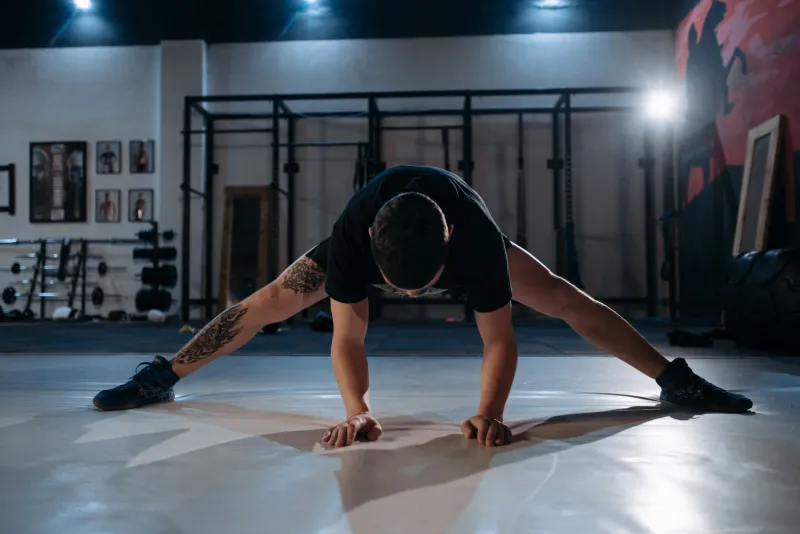
Picture the scene: you're at the gym, about to start a run or hit the weights. You bend over, grab your ankles, hold for thirty seconds, switch sides, maybe do a quad stretch against the wall. It feels disciplined. Responsible. Like you're doing exactly what your gym teacher drilled into you in sixth grade.
That instinct is nearly universal among American exercisers. And according to two decades of sports medicine research, it may be doing the opposite of what you think.
The Habit Nobody Questions
Static stretching — the kind where you hold a position for fifteen to sixty seconds — became embedded in American fitness culture through physical education programs starting in the 1950s and 60s. The logic seemed airtight: muscles are like rubber bands, cold rubber bands snap, so you stretch them out before asking them to do hard things. It made intuitive sense, gym teachers taught it, coaches reinforced it, and parents passed it down.
The problem is that muscles aren't rubber bands. And the "cold muscle" metaphor, while vivid, doesn't accurately describe what's happening in your tissue before exercise.
By the early 2000s, researchers were publishing studies that made physical therapists and sports scientists genuinely uncomfortable — not because the findings were fringe, but because they directly contradicted something virtually every coach and trainer was confidently telling people every single day.
What the Research Actually Found
A landmark review published in the Scandinavian Journal of Medicine and Science in Sports analyzed dozens of studies on pre-exercise stretching and came to a conclusion that surprised the fitness world: static stretching before activity consistently reduced muscle strength, power output, and performance — sometimes by as much as 8 percent in the short term.
That's not a rounding error. For a sprinter, a basketball player, or even someone doing heavy squats, an 8 percent reduction in force output is meaningful.
The mechanism isn't complicated once you understand it. Static stretching doesn't "warm up" a muscle — it actually temporarily reduces the stiffness that muscles rely on to generate explosive force. Think of it less like loosening a rubber band and more like slightly deflating a tire before a race. The muscle becomes more pliable, yes, but also less mechanically efficient at the exact moment you need it to perform.
On the injury side, the picture is similarly complicated. Multiple large-scale reviews have found that static stretching before exercise shows little to no consistent reduction in acute injury rates. The intuitive story — stretch it out, it won't tear — doesn't hold up when you look at the data across sports and activity types.
So Why Does the Myth Stick Around?
Several reasons, and they're worth understanding.
First, there's what researchers call survivorship bias in personal experience. You stretched before every workout for years and never got seriously hurt — so the stretching must be working. What you can't know is whether you would have gotten hurt anyway, or whether you would have been just as fine without it. Personal experience is a terrible way to evaluate injury prevention strategies.
Second, the ritual itself feels good. A slow, held stretch produces a genuine sensation of release. That feeling is real — it's your nervous system adapting to the stretch — but feeling good and being protective aren't the same thing.
Third, physical education infrastructure moves slowly. Gym teachers teach what they were taught. Coaches repeat what worked for their coaches. Fitness culture has enormous inertia, and "we've always done it this way" is a powerful force even when the science has moved on.
Finally, the updated recommendations — dynamic warm-ups — are less intuitive and harder to explain in a thirty-second locker room conversation than "stretch before you lift."
What Physical Therapists Actually Recommend Now
The current consensus in sports medicine and physical therapy has shifted firmly toward dynamic warm-ups before exercise. Instead of holding still positions, a dynamic warm-up involves controlled movement through a range of motion — leg swings, hip circles, arm rotations, light jogging, bodyweight squats, walking lunges.
The difference matters. Dynamic movement gradually increases blood flow to working muscles, raises tissue temperature, activates the neuromuscular connections between your brain and your muscle fibers, and prepares your joints for the specific demands of the activity ahead. It does what people always thought static stretching was doing — without the temporary performance reduction.
The general guideline from most sports medicine professionals now looks something like this:
- Before exercise: Five to ten minutes of dynamic movement specific to what you're about to do
- After exercise: That's when static stretching actually earns its place — when muscles are genuinely warm and pliable, and when improved flexibility is the actual goal
Post-workout static stretching can meaningfully improve flexibility over time and may help with recovery. The timing matters. Doing it after exercise instead of before isn't just semantics — it changes what the stretch is actually accomplishing.
The Takeaway
Stretching before a workout isn't dangerous in any dramatic sense — it's not going to injure you on its own. But the belief that it's protecting you, preparing your muscles, or reducing your injury risk isn't well-supported by the research that's accumulated since the 1990s. The habit persists because it feels right, it was taught with authority, and nobody really questions the things they learned in gym class.
If you want to actually prepare your body before a workout, move through it — don't hold still in it. Save the long, slow stretches for when you're already warm. Your muscles will be in a much better position to benefit, and so will your performance.
Sometimes the most responsible-looking thing in the room isn't the most useful one.